
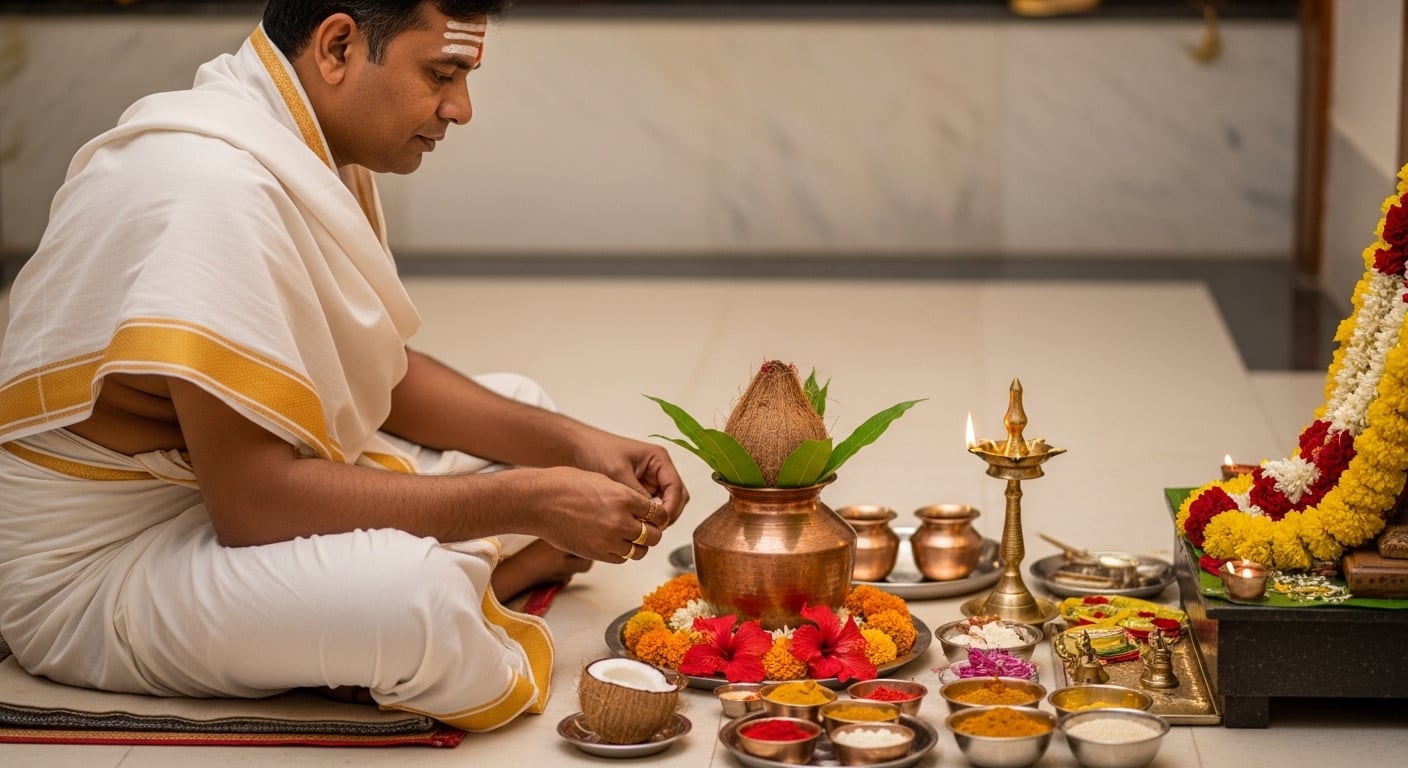
Explore sraddha ritual Hindu with practical guidance, clearer next steps, and Delhi NCR booking context from Navdhya. Read practical guidance, common questions, and helpful next...
Need help planning this ritual? Book a puja or talk to Navdhya.
Why sraddha ritual Hindu still matters in Hindu understanding
Many readers begin with a simple question: why does sraddha ritual Hindu matter in the first place. Navdhya approaches this topic as part of a larger effort to make Vedic learning more understandable for modern families. Learn why sraddha rituals matter in Hindu tradition and how ancestral rites are understood in family life.|Educational guide to sraddha, their Vedic basis, and how Navdhya supports families in performing them.
The value of this subject is not limited to scholars or priests. In practice, topics such as ancestor worship, pitru karma shape how families think about worship, duty, prayer, and the meaning of ritual in everyday life. That is why Navdhya treats the subject as something worth explaining with clarity rather than assuming prior knowledge.
For modern readers, the challenge is often not lack of respect for tradition, but lack of access to good explanation. Navdhya uses education pages like this one to help readers move from surface familiarity to a more stable understanding of why the concept continues to matter.
This fuller understanding is especially valuable for households trying to connect study with practice. When the meaning of a term becomes clearer, puja, ritual discussion, and family learning all become easier to approach with confidence.
The traditional background behind Importance of Sraddha Rituals
Every major ritual idea has a background in scripture, practice, or inherited teaching. Navdhya
When a concept is seen in context, it becomes easier to understand how it moved from textual tradition into living household practice. Navdhya uses that approach so the reader can connect doctrine, ceremony, and family observance more naturally.
This background also helps prevent common simplifications. A concept that seems small in isolation may carry a much deeper role when viewed against the long history of ritual, commentary, household custom, and the practical needs of worshippers across generations.
Readers often discover that what first looked like a narrow ritual detail is actually linked to broader ideas of duty, devotion, memory, symbolism, or sacred order. That layered background is one reason these guides aim for depth rather than quick summary alone.
How sraddha ritual Hindu appears in real ritual life
A concept becomes meaningful when it can be recognized in lived practice. Navdhya therefore
This practical framing matters because many families encounter the topic not in a classroom, but while preparing for a puja, watching a ceremony, or asking why a familiar custom exists. Navdhya builds its explanations around that real-world encounter.
When readers can connect the idea to ritual action, symbolism, or family observance, it stops feeling distant. Navdhya wants the subject to feel both intellectually clear and spiritually relevant, especially for households trying to keep tradition active in daily life.
Practical recognition also makes learning easier to remember. A reader who can identify the concept inside a known festival, ceremony, chant, or household custom is much more likely to retain the teaching and apply it in future worship.
Common misunderstandings and modern questions
Modern readers often meet ancient terms through fragments, forwarded summaries, or social media explanations that remove context. Navdhya tries to correct that by addressing the most common misunderstandings around sraddha ritual Hindu in a calm and grounded way.
That effort is especially useful when the subject touches ritual meaning, ethical behavior, or symbolic action. Clear explanation helps the reader move beyond superficial interpretation and see why the topic continues to matter in Hindu thought.
Many misunderstandings arise because a topic is detached from its proper ritual setting or reduced to a slogan. Navdhya responds by restoring explanation, examples, and devotional context so the reader can evaluate the idea more carefully.
This is one of the reasons educational writing still matters even in an age of quick answers. A concept becomes more useful and more faithful to tradition when readers are given enough context to think with care instead of reacting to fragments.
How Navdhya teaches this topic to families today
Navdhya presents educational guides like this one because households often want learning that is respectful, practical, and relevant to ritual life. sraddha ritual Hindu is easier to retain when it is explained alongside ceremony, worship, and household observance rather than as isolated theory.
This teaching style also supports intergenerational learning. Navdhya wants parents, younger readers, and first-time learners to be able to approach the subject with enough depth to appreciate it and enough clarity to discuss it meaningfully.
Education also supports confidence. Families are more likely to ask good questions, participate more intentionally, and preserve ritual continuity when explanation feels trustworthy. Navdhya sees that educational function as part of the wider spiritual service mission.
A clearer teaching style can also support conversation within the home. Parents, elders, and younger readers often need a shared vocabulary if they are going to discuss worship and ritual meaning in a way that strengthens family continuity.
Why learning about sraddha ritual Hindu deepens practice
Studying sraddha ritual Hindu does more than answer a vocabulary question. It helps readers understand how Hindu ritual, devotion, and spiritual responsibility fit together. Navdhya sees that deeper understanding as one of the strongest reasons educational content matters.
When a family understands the meaning behind practice, worship often becomes more intentional and more rooted. That is why Navdhya continues to publish guides like this one: they help tradition remain not only inherited, but consciously understood.
In the long run, that kind of understanding strengthens both ritual participation and cultural continuity. Navdhya wants readers to leave the page with more than a definition - it wants them to leave with a framework that makes future worship and study feel richer.
That is ultimately why long-form education matters. When the subject is understood with enough patience and context, the reader is better prepared not only to describe it, but also to recognize its value inside living Hindu practice.
Helpful next steps
Need help planning this ritual? Book a puja or talk to Navdhya.