
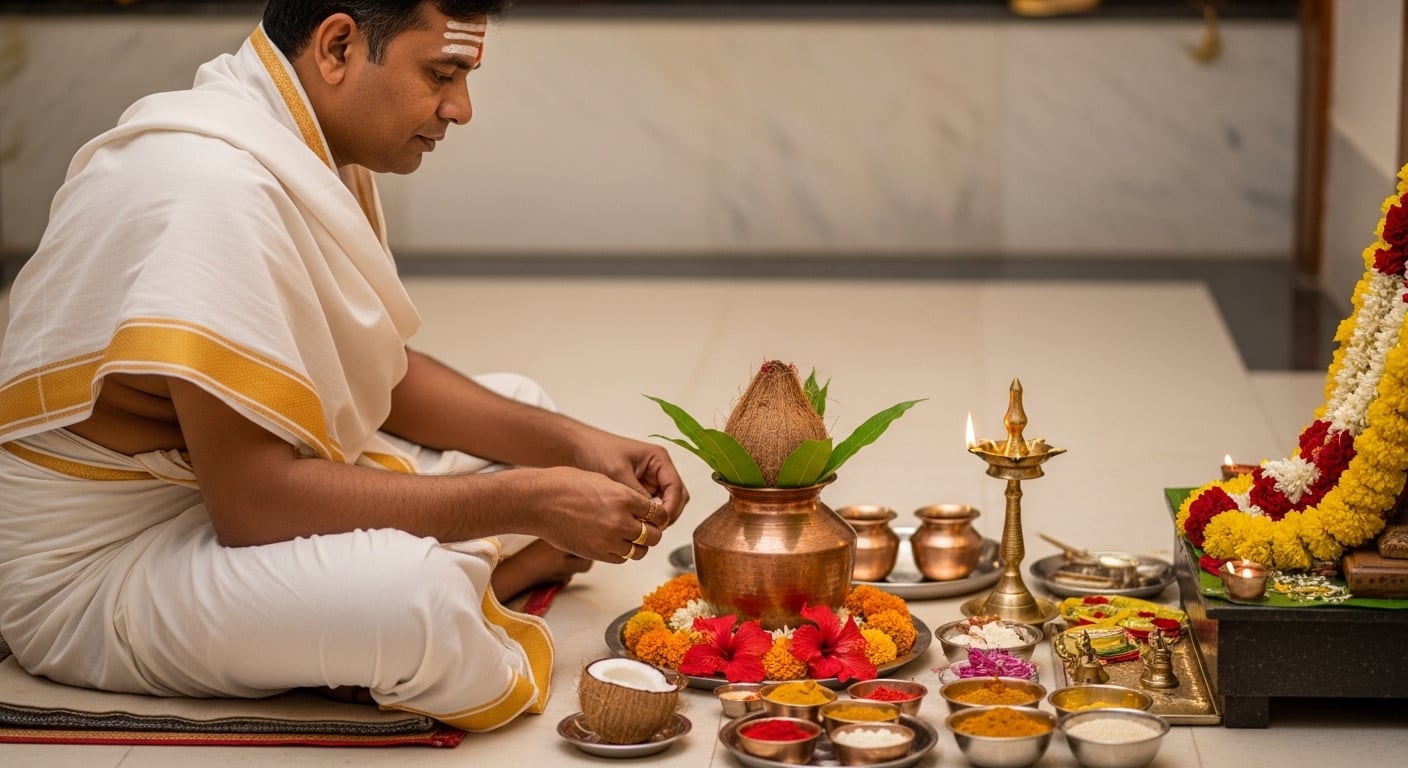
See how Navdhya helps urban families keep Vedic rituals practical, authentic, and stress-free through verified priests and guided booking.
Want a clearer next step? Learn about Navdhya or speak with our team.
Why modern families still want traditional rituals
Urban life changes schedules, housing patterns, and family routines, but it does not erase the desire for sacred continuity. Families still want to observe griha pravesh, Satyanarayan puja, naming ceremonies, festival rituals, and other important observances with sincerity. What has changed is the amount of time available to organise those moments. Many households are managing work calendars, school schedules, elder care, travel, and apartment living all at once. Navdhya exists in that reality. It is designed for families who want authentic Vedic rituals without feeling forced to choose between tradition and modern life.
For many households, the real difficulty is not devotion. It is coordination. Finding a priest, confirming the right ceremony, arranging materials, understanding household preparation, and ensuring that relatives can participate are all separate tasks. Navdhya brings those moving pieces into one guided process. That is why Navdhya for modern families is not just a slogan. It is a service model shaped around how urban Hindu households actually live today.
Navdhya reduces the friction that usually surrounds ritual planning
Traditional ceremonies often become stressful because each step is handled through a different channel. One person shares a priest number, another suggests a material list, someone else recommends a muhurta, and the family ends up carrying the whole coordination burden. Navdhya reduces that friction by turning ritual planning into a more transparent and manageable experience. Families can understand service types, ask the right questions, and move toward a confirmed booking with less uncertainty.
This matters especially for first-generation urban households that are trying to preserve family customs while working inside tight time windows. Navdhya gives these families a structured way to book a ritual without flattening the spiritual meaning of the ceremony. The platform does not treat a puja like a generic appointment. Instead, Navdhya helps families understand what is involved, what preparation is needed, and how the day can run smoothly inside a real home environment.
Home puja support that fits apartment and city life
One reason Navdhya resonates with modern families is that it understands the practical conditions of city living. Many families live in apartments rather than large ancestral homes. Parking may be limited. Ceremony space may need to be arranged in a living room. Building timing restrictions may affect setup. Elderly parents may need seating support, while children may need the ritual to be explained in simple language. Navdhya is built around these realities rather than pretending they do not exist.
That practical awareness changes the experience. When Navdhya guides a home puja, the emphasis is on preserving sanctity while respecting the limits of an urban household. Families are not left guessing whether the ritual can be conducted properly in their current space. Instead, Navdhya helps translate traditional requirements into a workable plan for a contemporary home. This is one of the clearest ways Navdhya bridges tradition and everyday family life.
Online access keeps extended families connected
Modern families are often spread across cities and countries even when the core household remains in Delhi NCR. Parents may live in another city. Siblings may be overseas. Children may be studying away from home. In the past, distance often meant that spiritual participation became fragmented. Navdhya addresses that gap through online support and remote participation models that let more family members remain connected to important ceremonies.
For families who cannot gather physically, Navdhya online puja services create a meaningful bridge. The ceremony remains guided, intentional, and family-centered rather than reduced to passive viewing. That is particularly important for households trying to keep younger generations engaged with their traditions. Navdhya helps make rituals accessible across distance while still preserving the seriousness of sankalpa, family involvement, and correct procedure.
Authenticity matters even more when time is limited
Busy households are sometimes offered shortcuts in the name of convenience. That may sound useful at first, but most families do not want a ritual that feels rushed, improvised, or disconnected from tradition. They want efficiency around planning, not compromise inside the ceremony itself. Navdhya is valuable precisely because it separates those two things. The logistics become easier, but the commitment to Vedic authenticity remains intact.
That balance is central to how Navdhya serves modern families. Verified priests, clearer preparation guidance, and structured communication allow the household to stay calm, while the ritual itself remains rooted in proper conduct and reverence. Families do not have to become experts in every procedural detail before booking. Navdhya creates space for them to participate with understanding and confidence instead of anxiety.
Navdhya helps rituals stay part of family culture
The deeper value of Navdhya for modern families is cultural continuity. Rituals are not only events; they are ways of teaching memory, gratitude, reverence, and belonging across generations. When ceremonies become too difficult to organise, families sometimes postpone them repeatedly or stop observing them with the same fullness. Navdhya helps prevent that slow drift by making sacred observance more workable for contemporary households.
In practice, that means families can keep major ceremonies, annual observances, and household pujas inside their lives without turning each one into a logistical crisis. Navdhya supports the family that wants authenticity but also needs clarity, timing discipline, and service support. That is why Navdhya for families speaks directly to the modern Hindu household: it protects the ritual experience while making it more realistic to sustain year after year.
Helpful next steps
Want a clearer next step? Learn about Navdhya or speak with our team.